What hay species is best for horses?
Recently I had a customer say that he thought there was a perception among horse owners that timothy hay was superior to other hay species. This led to a short discussion about other species of hay commonly fed to horses in our area, fescue, orchard, and teff. So, I decided to pull what information I had on these forage species. Also knowing alfalfa is frequently mixed in with fescue and orchard for horse feed.
Because these are the most commonly submitted hay types for horse feed in our region, I pulled NIRS data on: fescue (n= 185), fescue x alfalfa (n= 72), orchard (n= 175), orchard x alfalfa (n= 204), teff (n = 131). Unfortunately I have limited data on timothy (n=14). All samples were submitted to Ward Laboratories, Inc. between 2020 – 2022 and analyzed using FOSS DS 2500 with NIRS Forage and Feed Testing Consortium Calibrations.
Meeting protein and energy requirements
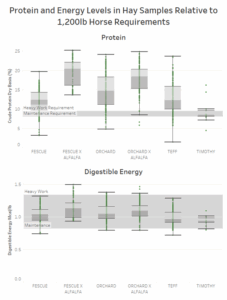
Figure 1 shows the range of sample values for both protein and calculated digestible energy. The gray band marks the nutritional requirements of a 1200lb horse at varying work loads from maintenance to heavy. Most hay samples we receive would meet or greatly exceed protein requirements for a horse. Timothy hay was the exception to this rule, but this is likely due to the low sample size to explore. Nearly all samples, across all species, met the maintenance requirements for an average horse. As the workload increases, the likelihood of hay meeting energy requirements decreases. This is why we provide grain supplements such as oats.
Hay carbohydrates and metabolic health
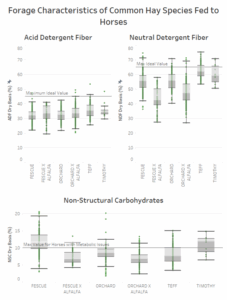
Figure 2 shows nearly all samples are at or below the threshold value recommended for acid detergent fiber (ADF) and amylase-treated neutral detergent fiber (NDF). Additionally, non-structural carbohydrates (NSC) are a common concern among owners of horses with metabolic conditions. NSC includes sugars and starches that can trigger issues like laminitis in horses with metabolic disorders. Most hay samples across these species are below the threshold value of 10% NSC. Fescue is the exception with most of these samples having too high sugar content for horses with metabolic conditions. Timothy samples are split, but again, I do not have enough samples in my dataset to draw any conclusions on timothy hay.
So, what does this mean for horse owners?
- Hay is variable no matter what species.
- Most hay will meet a horse’s requirement for protein.
- Energy supplementation needs will depend on both the energy level of the hay and work level of the horse. A hay analysis can help horse owners understand how much energy is in the hay, but not their horse’s workload. So, monitoring body condition is a good tool to ensure that horses are not over or under fed.
- Most of these hay species were not excessive in fiber content. So, most hays will provide fiber for gut health, but not so much that limited intake or impaction becomes a risk.
- Fescue hay should be tested for sugar content when being fed to horses with metabolic conditions. It has the highest likelihood to exceed NSC ideal threshold of 10%.
In conclusion, no single hay species stands out as the best option for all horses. The data shows that orchard grass, teff, and fescue mixes can all provide adequate nutrition. Most hay samples meet protein requirements and fall within acceptable fiber and sugar thresholds. However, fescue hay should be tested when feeding horses with metabolic concerns due to its higher likelihood of exceeding recommended sugar levels. Since hay quality varies widely within each species, testing and monitoring body condition remain the best tools for ensuring horses are receiving a balanced diet that supports their individual needs.