Heavy Metal Contamination in Specialty Crops: What Growers Need to Know
Heavy metal contamination in specialty crops is a unique challenge that requires lab analysis and potential remediation steps after. Unlike commodity crops that undergo processing, specialty crops are often eaten fresh. You cannot cook away heavy metals. This makes understanding soil contamination and crop selection critical for protecting both consumers and your operation.
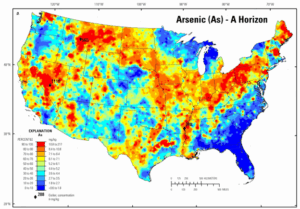
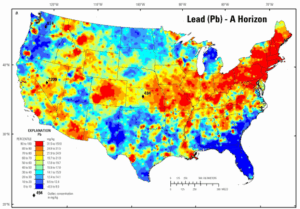
The health stakes are significant. Lead causes irreversible IQ loss in children and accumulates in bones for decades. Cadmium causes permanent kidney damage. Arsenic is a known carcinogen, breaking down proteins in the body. The insidious part is that harm comes from chronic, low-level exposure over years, with no symptoms until organ damage appears. This is why proactive testing matters.

Total vs. Available Metals: The Critical Distinction
Total metals testing (EPA 3050B) measures everything in the soil, but much of it is locked in minerals plants cannot access. DTPA-extractable metals testing measures what plants can actually take up. This distinction is critical for agricultural risk assessment.
Two soils with identical total cadmium can have vastly different risks. A soil at pH 6.8 might have only 2.5% of its cadmium available to plants, while another at pH 5.2 could have 20% available. The target pH of 6.5-6.8 minimizes availability of lead and cadmium while not significantly mobilizing arsenic. Always request both total and DTPA-extractable metals tests.

Crop Accumulation: Know Your Risk
The bioconcentration factor (BCF) predicts how much metal a crop will accumulate relative to soil concentration. A BCF above 1.0 means the crop concentrates that metal. The differences between crops are dramatic:
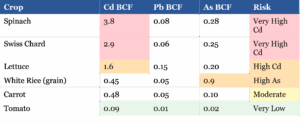
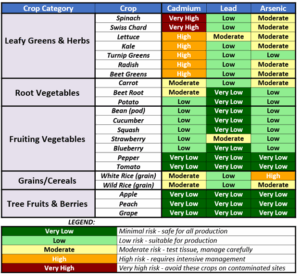
Leafy greens are cadmium hyperaccumulators. Spinach at BCF 3.8 actively concentrates cadmium nearly four-fold from soil to edible tissue. Rice presents a unique arsenic problem: flooded growing conditions chemically transform arsenic into more mobile forms, dramatically increasing uptake. The FDA limit of 100 ppb inorganic arsenic in infant rice cereal can be exceeded on soils with as little as 50 mg/kg arsenic. Fruiting vegetables like tomatoes are consistently safe across all three metals.
Remediation Options
The challenge with remediation is that different metals require different treatments. Lead and cadmium carry positive charges and respond to pH adjustment and organic matter binding. Arsenic carries a negative charge and can actually become more available with treatments that help the others. Matching the amendment to your specific contamination profile is essential.
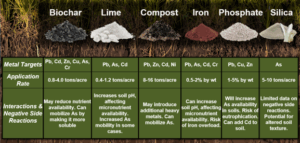
Lime (0.4-1.2 tons/acre):
Raises pH to precipitate Pb/Cd as insoluble carbonates. Target pH 6.5-6.8. Full effect in 6-12 months. Caution: pH above 7.0 increases arsenic mobility.
Phosphate (1-5% by weight):
Reacts with lead to form pyromorphite, a mineral 100-1,000 times less soluble than other lead forms. Reduces available lead by 70-90%. Caution: significantly increases arsenic availability.
Biochar (0.8-4 tons/acre):
Provides multiple mechanisms: direct adsorption, pH increase, high silica content, and redox stabilization. Reduces available Pb/Cd by 50-65% with effects lasting years. Caution: standard biochar can mobilize arsenic. Use iron-doped biochar for sites with arsenic contamination.
Silica (5-10 tons/acre):
Plant roots preferentially uptake silica over arsenate, competitively reducing arsenic accumulation in tissue. Best option specifically for arsenic.

Practical Management
Beyond amendments, simple practices reduce exposure significantly. Switching from overhead to drip irrigation eliminates soil splash onto leaves, which is the primary pathway for lead contamination on greens. Mulching with plastic or straw creates a physical barrier between contaminated soil and low-growing crops. For contaminated urban sites, raised beds (minimum 18 inches) with imported clean soil and a bottom barrier is the most reliable approach.
Action Steps
Start by testing your soil for both total metals and DTPA-extractable metals, plus pH. Use stainless steel sampling tools, not brass. Match your crop selection to your contamination profile using the BCF data above. If remediation is needed, choose amendments based on which metals are present, being especially careful about arsenic mobilization. Verify effectiveness with follow-up soil and tissue testing.
This is a legacy problem from historical pesticide use, industrial activity, and urban development. It is not your fault, but it is your responsibility to manage. Testing gives you the knowledge to make informed decisions that protect your customers, your reputation, and your operation.